Best Outdoor Pickleball Balls (2026)
The Franklin X-40 USA Pickleball Approved Tournament Pickleballs (about $10.39) are the most widely used outdoor ball in sanctioned and recreational play, thanks to consistent bounce and 40-hole durability on asphalt and concrete.

Beginner, intermediate and expert picks
Beginner
 Franklin Sports Pickleball-x Performance 40 Outdoor Balls-Optic$9.89
This is the cheapest way to try a name-brand outdoor ball, at about $9.89. It is a fine choice for casual driveway or park sessions where you are not chasing tournament certification. Compared to the tiers above it, expect balls to go out of round and crack sooner under aggressive, frequent rec play on rough asphalt.
Check priceIntermediate
 Dura Fast 40 Pickleballs Outdoor pickleball balls$18.00
The Dura Fast 40 (about $18) is one of the most recommended outdoor balls among regular players, a step up from bargain multi-packs for anyone who wants a ball that holds its round shape and true bounce through repeated outdoor sessions. It costs more per ball than the beginner option but noticeably less than premium hardcourt balls.
Check priceExpert
 JOOLA HC-40 Hardcourt Pickleball Balls with Storage Tube$35.82
The JOOLA HC-40 Hardcourt balls (about $35.82) ship in their own storage tube and are built specifically for hardcourt play, where surface abrasion cracks cheaper balls fastest. It is a sensible upgrade for players logging several outdoor sessions a week on rough concrete.
Skip it if:Players who only get outside once or twice a month do not need this tier; the extra durability and storage tube cost more than a casual schedule will ever use.
Check priceOutdoor pickleball balls are built differently from indoor balls, and picking the wrong one is the single most common reason a new player thinks the sport feels "off." If you are outfitting a bag for the first time, run your gear list through the ball count calculator so you buy enough balls for how often you actually play, and use the pickleball ball chart to compare hole counts and hardness at a glance.
What makes a pickleball ball an outdoor ball?
Outdoor balls are molded with 40 small holes arranged in a specific pattern, and the plastic itself is formulated to be harder and slightly heavier than an indoor ball. That extra hardness matters because outdoor play happens on asphalt, concrete, or textured acrylic court surfaces and often in some wind. A softer ball would deform too easily against rough pavement and would get pushed around by even a light breeze. The tradeoff is that outdoor balls sting more on mishits and can crack instead of just going soft. Products like the Franklin X-40 Tournament balls and the Dura Fast 40 are built around this exact 40-hole, hardcourt-ready design.
How long do outdoor pickleball balls last before they crack?
There is no fixed lifespan because it depends entirely on the surface you play on and how often you play. On smooth, well-sealed courts, a well-made outdoor ball can survive many sessions over several months. On rough asphalt with cracks and pebble texture, the same ball can develop a hairline crack in a single afternoon of hard rallies. The failure pattern is usually the same: the ball starts to go slightly out of round, then a crack appears near one of the molded seams, and once that happens the bounce becomes unpredictable and it is time to retire it. Budget balls like the Franklin Sports Performance 40 Optic balls tend to show wear fastest on rough courts, while hardcourt-specific balls such as the JOOLA HC-40 are made to resist that abrasion longer. A simple rule that works for most players: keep a rotation of at least six to twelve balls per regular playing group so a cracked ball never stops a game, and retire any ball as soon as you notice it wobbling instead of bouncing true.
Dura Fast 40 vs Franklin X-40: which outdoor ball should you buy?
These are the two names you will see recommended most often for outdoor play, and both are reasonable defaults. The table below compares the versions in this guide along with a couple of other popular options.
| Ball | About | Best for |
|---|---|---|
| Franklin X-40 USA Pickleball Approved Tournament | $10.39 | League and tournament play where approval status matters |
| Dura Fast 40 | $18 | Regular outdoor rec play, good all-around durability |
| Selkirk Sport Pro S1 | $9.99 | Budget-conscious buyers who still want a trusted paddle-brand ball |
| Magicorange 40-Hole Outdoor | $20.99 | Players who want a USA Pickleball approved option outside the two big names |
| JOOLA HC-40 Hardcourt | $35.82 | Frequent hardcourt players who want maximum crack resistance |
If you are buying for a home court or driveway setup, it is also worth checking your court dimensions against your available space before you invest heavily in gear, since ball choice matters less than having room to actually play a full rally.
What is USA Pickleball approval and does it matter for rec play?
USA Pickleball maintains an approved equipment list that covers balls, paddles, and nets meeting the sport's official specifications for size, weight, bounce, and hole pattern. If you play in a sanctioned league or tournament, you generally need an approved ball, and the Franklin X-40 Tournament and Magicorange balls in this guide are marketed as approved. For casual driveway or park games, approval status is nice to have but not required. What actually matters more for casual play is consistency: a ball that bounces the same way every time makes it much easier to learn timing and spin, which is why we still recommend sticking to a known, well-reviewed ball even for backyard games.
How many outdoor balls should you keep in rotation?
Most regular players keep somewhere between six and a dozen balls on hand, since it is common to lose one over a fence or crack one mid-session. If you host games for a group, buying a larger multi-pack like the Navona 48-Pack keeps cost per ball low and means you are never stuck mid-game with nothing left. Solo players or those just trying the sport can start with a smaller pack, such as the Onix Fuse G2 six-pack, and reorder once they know how often balls actually crack on their court.
Do outdoor balls play differently as the seasons change?
Plastic gets stiffer in cold weather and slightly softer in heat, so the same ball can feel a little livelier on a hot afternoon and a little dead and prone to cracking on a cold morning. This is normal and not a sign of a defective ball. If you play year-round in a climate with real winters, expect to go through balls a bit faster in cold months and budget for it rather than assuming something is wrong with your equipment.
What does the price difference between outdoor balls actually buy you?
Prices in this category span from about $9.89 to about $35.82, and that gap is not just brand markup. Cheaper balls generally use a simpler single-formula plastic and looser manufacturing tolerances, so ball-to-ball consistency can vary a bit more within the same bag. Mid-priced options like the Dura Fast 40 and Magicorange 40-Hole balls tend to use tighter molding tolerances, which owners report as steadier bounce from ball to ball. At the top of the range, a ball like the JOOLA HC-40 adds a dedicated storage tube and is marketed specifically around hardcourt abrasion resistance, which is the kind of feature that pays off only if you are playing on rough pavement often enough to notice it. For a casual player who mostly cares about a fair, repeatable bounce, the middle of the price range covers nearly everyone's needs without paying for durability features they will rarely stress-test.
Buying outdoor pickleball balls in bulk for leagues and clubs
If you are stocking a club, a regular meetup, or a family that plays often, buying single small packs adds up fast and means someone is constantly reordering. A large multi-pack, such as the Navona 48-Pack Premium Outdoor balls, brings the cost per ball down meaningfully compared to buying six-packs one at a time, and it means a torn pocket in your bag does not turn into an empty one mid-session. The tradeoff is upfront cost and storage space, since 48 balls take up more room in a bag or bin than a small sleeve of six. For most single households or small friend groups, a mid-size pack strikes a better balance; for anyone running organized weekly sessions for a larger group, buying in bulk once or twice a year is usually the more economical approach.
Does color or brand matter for outdoor pickleball balls?
Color is mostly a visibility preference rather than a performance factor. Bright optic yellow, used on balls like the Franklin Sports Performance 40 Optic, is popular because it stands out well against asphalt, grass backdrops, and cloudy skies alike. Brand matters more for consistency and quality control than for any fundamental difference in how the ball is supposed to play, since all of these balls are built around the same 40-hole outdoor specification. Sticking with a well-reviewed, established brand such as Franklin, Onix, Selkirk, or JOOLA is a reasonable way to avoid the inconsistent batches that sometimes show up in reviews of lesser-known off-brand balls.
How we chose
Everything above comes from published product specifications, USA Pickleball's public approved-equipment listings, and patterns reported across verified owner reviews. We did not play-test these balls ourselves, and any recommendation about durability reflects what owners commonly report rather than in-house testing. Prices are shown as "about" because Amazon pricing changes frequently, so always confirm current price before buying.
Buying tips
- Match the ball to your surface: smoother courts are easier on any ball, rough asphalt calls for a hardcourt-rated option like the JOOLA HC-40.
- Buy more balls than you think you need. Running out mid-session is the most common complaint in owner reviews, not ball quality.
- Do not assume a cheaper ball is a worse ball for casual play; several budget options here are approved and well reviewed. Save the premium tier for players logging serious weekly hours outdoors.
- If you are also comparing indoor options, read our indoor vs outdoor pickleball balls guide before you buy, since the two are not interchangeable.
Also worth considering
 Selkirk Sport Pro S1 Ball
  DURA Onix Fast 40 Outdoor Pickleballs
 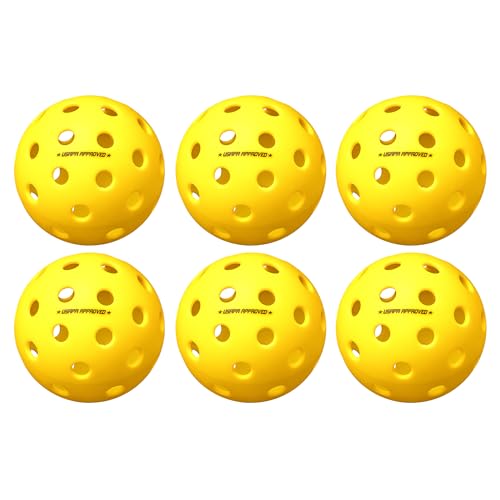 Onix Fuse G2 Outdoor Pickleball Balls
  Amazon Basics Outdoor Pickleball Balls
  Magicorange Pickleball Balls,USAPA Approved 40 Holes Outdoor
  Navona 48 Pack Premium Outdoor Pickleball Balls
 Email me these picks
Every item on this page with its current price, in one email, so you can shop it later or in pieces. No sales sequence.
Used only to send the list. You can also just read it here.Frequently asked questions
How many holes do outdoor pickleballs have?
Standard outdoor pickleballs have 40 holes, molded into a harder plastic than indoor balls so they hold up on asphalt and concrete and resist wind. Indoor balls typically have 26 larger holes and a softer shell built for gym floors, so the two are not interchangeable if you want consistent play.
Why do outdoor pickleballs crack?
Cracking is caused by repeated impact against hard, rough surfaces like asphalt, plus UV exposure and temperature swings that make plastic more brittle over time. A ball that starts wobbling instead of bouncing true is usually developing a hairline crack near a seam and should be retired before it affects play.
Are Dura Fast 40 balls approved for tournament play?
Check the current USA Pickleball approved equipment list before entering a sanctioned event, since approval status can change and is not always printed clearly on the package. For casual and league play where approval is not required, the Dura Fast 40 is a widely used, well-reviewed choice.
Can I use an indoor ball outdoors?
You can, but it will not last. Indoor balls are softer and lighter, so they deform quickly against pavement, get pushed around by wind, and typically crack faster outdoors than a purpose-built 40-hole outdoor ball would.
How much do outdoor pickleballs cost?
Outdoor pickleballs in this guide range from about $9.89 for a budget multi-pack to about $35.82 for a premium hardcourt option with its own storage tube. Buying larger multi-packs, like a 48-pack, generally lowers the cost per ball for groups that play often.
Do outdoor pickleballs play differently in cold weather?
Yes. Plastic stiffens in cold temperatures, which can make the ball feel less lively and slightly more prone to cracking, while heat can make it feel a bit softer. This is a normal property of the material, not a defect in any specific ball.
Researched from published specs and verified owner reviews, not play-tested by us, and not professional advice. Heavier paddles add load on the elbow and shoulder; ask a doctor or physical therapist about joint pain.