Pickleball Court Dimensions: Size, Kitchen, and Net Height
A pickleball court is 20 feet wide by 44 feet long for both singles and doubles, with a 7 foot non-volley zone (the kitchen) on each side of the net and lines 2 inches wide.

Every pickleball court, from a backyard driveway to a tournament stadium court, follows the same core numbers. Once you know them, laying out a court with a court size calculator or a roll of tape is mostly arithmetic. This guide covers the official playing surface, the kitchen, net height, and how much total land you actually need once you account for run-off space around the lines.
What are the official pickleball court dimensions?
The playing surface is 20 feet wide by 44 feet long, for both singles and doubles. That is one of the more surprising facts for anyone coming from tennis: tennis has separate singles and doubles widths, but pickleball does not. The court is split by the net into two 20 by 22 foot halves, and each half is further divided by the centerline into two service courts.
Are singles and doubles courts the same size in pickleball?
Yes. Unlike tennis, where doubles play uses a wider court with alley strips, pickleball singles and doubles are played on the exact same 20 by 44 foot rectangle. Singles players simply serve into the same diagonal service boxes doubles players use, and there is no separate singles line to paint or tape. This is one reason a backyard pickleball court is cheaper to build than a backyard tennis court: you only ever need one set of lines.
How big is the kitchen (non-volley zone)?
The non-volley zone, universally nicknamed the kitchen, extends 7 feet back from the net on each side, running the full 20 foot width of the court. That means the two kitchens together take up 14 of the court's 44 feet of length, leaving 15 feet of court behind each kitchen line for groundstrokes and serves. Players cannot volley the ball (hit it out of the air) while standing inside this zone, though they can step in to hit a ball that has already bounced.
How wide are pickleball court lines, and do they count as in or out?
Lines are 2 inches wide. A ball that lands on any part of a line, including the kitchen line, is considered in. This 2 inch width is the standard used by USA Pickleball, the sport's governing body, and it matters when you are laying out your own court: a court line kit that lays down anything narrower or wider than 2 inches will not match a regulation court, which can throw off close line calls during real play.
What height is the pickleball net?
The net is 36 inches tall at the sidelines and 34 inches tall at the center. That 2 inch sag in the middle is intentional and built into every regulation net, either through the way the net is strung or through a center strap that pulls it down slightly. A net that measures 36 inches straight across, with no dip in the middle, is not set up to regulation height and will play differently than what you would see at a sanctioned tournament.
How much total space do you need for a court?
The 20 by 44 foot rectangle is just the playing surface. You also need run-off room on every side so players are not chasing balls into a fence or stepping off a slab mid-swing. USA Pickleball recommends a minimum total playing area of 30 by 60 feet for recreational courts, and a preferred area of 34 by 64 feet for tournament-level courts, which gives more buffer behind the baselines and outside the sidelines. If you are working with a smaller backyard, this is usually the number that determines whether a full court fits at all, more than the 20 by 44 foot surface itself.
| Space | Width | Length | Best for |
|---|---|---|---|
| Playing surface only | 20 ft | 44 ft | The lines themselves, no buffer |
| Minimum recommended total | 30 ft | 60 ft | Backyard and community courts |
| Preferred tournament total | 34 ft | 64 ft | Clubs and competitive play |
What are smaller pickleball court dimensions if I do not have a full backyard?
If a 30 by 60 foot footprint will not fit, most builders shrink the buffer space first rather than the court itself, since a 20 by 44 foot playing surface is the minimum needed for a real game. A tight backyard layout might get away with 24 by 50 feet of total space, which is workable for casual family play but leaves very little room to chase down a lob near the fence line, and some line calls near the edges become harder because there is no clear out-of-bounds buffer. For anyone this cramped, a portable net fit calculator is worth running before you buy a net, since some regulation-width nets will not physically fit a shortened layout.
Do I need to measure the diagonal to check my court is square?
Yes, and this is the step most first-time builders skip. Because the court is a rectangle, both diagonals (corner to opposite corner) should measure exactly the same length. If they do not match, the rectangle is skewed, and lines that look straight up close will drift off over 44 feet. Measuring both diagonals with a long tape before committing to paint or a court line kit catches this in minutes instead of after the fact.
Which direction should a pickleball court face?
A north-south orientation, meaning the net runs roughly east to west, is generally preferred for outdoor courts because it keeps the sun lower and more to the sides during peak morning and evening play rather than directly in a player's eyes while serving or returning. This is not a rule in the way the 20 by 44 foot rectangle is a rule; it is a practical layout choice. If your yard or lot only allows an east-west orientation, the court will still be fully regulation, but players facing directly into a low morning or evening sun may find it harder to track the ball during certain hours.
How much space do you need between two side-by-side courts?
If you are laying out more than one court, such as the 4-court layout that fits inside a full tennis enclosure, leave a buffer between adjacent courts so players are not colliding with a neighboring court's action. A gap of roughly 10 feet between courts is a common working minimum, with 12 to 15 feet preferred where space allows, giving enough room for a player to retreat for a lob without stepping onto the next court. This spacing is separate from the run-off space needed behind each court's own baselines, so multi-court facilities need both figured into the total footprint.
What net actually meets these height numbers?
Not every portable net on the market ships pre-set to 36 inches at the sidelines and 34 at the center, and many need the center strap tensioned correctly after setup to hit that dip. Nets with a wheeled frame and a crank tensioning system, like TYRSEN Pro 22ft Pickleball Net with Hand Crank Tension System, make it easier to dial in the exact height and keep it there across a season, rather than re-measuring by hand every time the net is moved. A simpler wheeled option like BAGAIL Portable Pickleball Net Set with Wheels covers the same regulation width and height for less money and is a reasonable choice for a driveway or garage court that gets set up and put away often.
How do I actually mark the lines once I know the dimensions?
Two approaches cover most backyard builds. The first is a temporary marking kit, which uses chalk, spray, or removable tape and is meant to be redone every season; something like SONICTOP Pickleball Court Marking Kit is inexpensive and fine for a driveway that gets repainted or re-taped periodically. The second is a semi-permanent kit meant to last multiple seasons outdoors, such as Murray Sporting Goods Premium Pickleball Court Marking Kit, which uses a heavier adhesive tape rated for weather exposure. If you want lines you can pull up and store between uses, a set like Cortable Temporary Pickleball Court Lines is built specifically to be temporary rather than adhesive.
Whatever you use to mark the court, keep the 2 inch line width and the 20 by 44 foot rectangle as your two fixed numbers, then work outward to whatever total footprint your yard can spare. For a full breakdown of surface options once you have the space measured out, see the guide on building a backyard pickleball court.
Gear mentioned in this guide
 SONICTOP Pickleball Court Marking Kit
  CourtKit Pickleball Court Marking Kit
 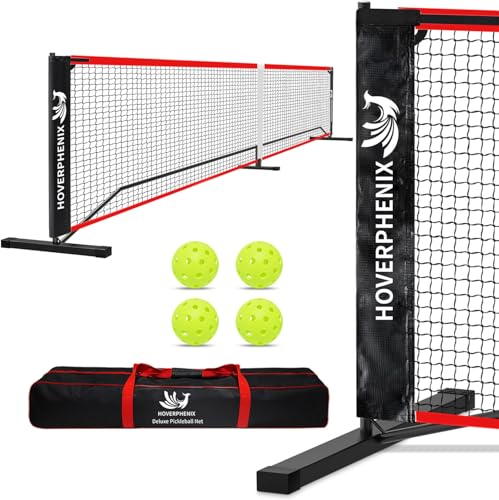 Hoverphenix 22FT Regulation Size Pickleball Net with Outdoor Pickleballs
  Cortable Temporary Pickleball Court Lines
  Murray Sporting Goods Premium Pickleball Court Marking Kit
  TYRSEN Pro 22ft Pickleball Net with Hand Crank Tension System
 Email me this guide's gear list
Every item on this page with its current price, in one email, so you can shop it later or in pieces. No sales sequence.
Used only to send the list. You can also just read it here.Frequently asked questions
What are the official pickleball court dimensions?
A pickleball court measures 20 feet wide by 44 feet long for both singles and doubles play. That surface is divided by the net into two halves, and each half is split again by the centerline into two service courts for serving.
How big is the kitchen on a pickleball court?
The non-volley zone, called the kitchen, extends 7 feet back from the net on each side and spans the full 20 foot width of the court. Together the two kitchens take up 14 of the court's 44 feet of total length.
Is the net height different at the center than at the sidelines?
Yes. The net is 36 inches tall at the sidelines and 34 inches tall at the center, with an intentional 2 inch dip built into regulation nets, either through the netting itself or a center strap.
Are singles and doubles pickleball courts the same size?
Yes, singles and doubles use the identical 20 by 44 foot court in pickleball. This differs from tennis, which uses a wider court for doubles, so a pickleball court only ever needs one set of lines.
How much total space do I need to build a pickleball court?
Beyond the 20 by 44 foot playing surface, plan for at least 30 by 60 feet of total space for casual play, with 34 by 64 feet preferred for tournament-level buffer around the baselines and sidelines.
What is the smallest space a pickleball court can fit into?
The playing surface itself needs a minimum of 20 by 44 feet, since that is the regulation rectangle. Shrinking further than roughly 24 by 50 feet total starts to cut into the buffer space needed to safely chase balls near the fence.
General information and estimates, not professional advice. Check local permits, setbacks and HOA rules and get local quotes before building.