Best Pickleball Shoes for Women (2026)
The ASICS Gel-RENMA 2 Pickleball Shoes, about $90, are the best all-around pick for women because they are a dedicated pickleball shoe rather than a repurposed running or tennis shoe.

The ASICS Gel-RENMA 2 Pickleball Shoes are about $90 and built as a dedicated pickleball shoe, ASICS' second version of a line designed specifically for the sport rather than adapted from tennis or volleyball. This is the shoe most women moving past a first pair should land on.
Beginner, intermediate and expert picks
Beginner
 ASICS Women's Upcourt 6 Volleyball Shoes$64.95
The ASICS Upcourt 6 Volleyball Shoes are about $65, the cheapest true court shoe in the women's catalog. Volleyball shoes share the same lateral cutting and quick-stop demands as pickleball, which makes this a solid entry-level court shoe rather than a running shoe pressed into service. Moving up a tier buys a shoe built specifically for pickleball rather than adapted from another court sport.
Check priceIntermediate
ASICS Women's Gel-RENMA 2 Pickleball Shoes$89.95The ASICS Gel-RENMA 2 Pickleball Shoes are about $90 and built as a dedicated pickleball shoe, ASICS' second version of a line designed specifically for the sport rather than adapted from tennis or volleyball. This is the shoe most women moving past a first pair should land on.
Check priceExpert
 ASICS Women's Gel-Resolution X Tennis Shoes$164.95
The ASICS Gel-Resolution X Tennis Shoes sit at the top of the women's catalog at about $165. This is ASICS' flagship stability tennis shoe, built with the most reinforced sides and durable outsole compound in the lineup for players logging the most hours on court.
Skip it if:Skip this if you play casually once or twice a month; it is a tennis-first stability shoe built for frequent, hard-cutting play, and its extra reinforcement and cost go mostly unused at casual playing frequency.
Check priceThe most common shoe mistake women make heading to a pickleball court is bringing a running shoe instead of a court shoe. Pickleball demands sudden lateral cuts, quick stops, and split steps at the net, none of which a typical everyday running shoe is actually built for. Before buying anything, check the court size calculator to see just how much side-to-side ground a single court actually covers in a normal rally.
Why do running shoes not work well for pickleball?
Running shoes use a rounded heel and a softer midsole built to cushion repeated forward impact on pavement or a treadmill, not to resist a foot rolling sideways. That rounded construction can roll under your foot during a fast lateral movement, which raises the risk of an ankle roll. Court shoes, every shoe on this page included, use a flatter, harder outsole and reinforced sides specifically to resist that sideways roll, along with a tread pattern built to grip a hard court rather than a road surface.
Pickleball shoe, tennis shoe, or volleyball shoe: does it matter which one you buy?
Less than you might think. All three sports share the same core demand: fast lateral cuts, quick stops, and repeated changes of direction on a hard court. That is why the beginner pick on this page is technically a volleyball shoe, and the expert pick is technically a tennis shoe, and both work perfectly well for pickleball. The one detail worth checking before you buy is whether the outsole is non-marking, since most indoor pickleball facilities require it regardless of which sport the shoe was originally designed for.
How much should you spend on pickleball shoes?
It should scale with how often you play, not with what feels impressive. A once-a-week social player gets nearly all the benefit of a real court shoe just by moving off a running shoe, and does not need the most reinforced, most expensive pair on the shelf. A player logging several sessions a week, especially anyone playing more competitively with frequent hard cuts, gets real value from the added side reinforcement and more durable outsole compound in the higher tiers here, since that reinforcement is what wears out first under heavy lateral use.
How should a pickleball shoe fit?
A court shoe should fit snugly through the midfoot and heel, with roughly a thumb's width of space between your longest toe and the front of the shoe, similar to standard running shoe sizing guidance. The key difference from a running shoe is the sides: the upper across your midfoot should feel secure and resist collapsing when you push off laterally, since a loose fit there is what actually lets your foot slide inside the shoe during a hard cut, straining the ankle even when the outsole itself grips well. If you have wide feet or a narrow heel, check the listing for width options before buying, since several lines here, including the ASICS Gel-Dedicate and Gel-RENMA families, run true to standard width.
Does the court surface change which shoe you should buy?
Somewhat. Outdoor hard courts are more abrasive and wear an outsole down faster, which favors a more durable rubber compound like the higher-priced picks on this page if you play outside regularly. Indoor courts, typically a sport court surface or hardwood gym floor, require a non-marking outsole to avoid scuffing the floor, and most facilities enforce this strictly. Nearly every shoe built specifically for pickleball, tennis, or volleyball meets that non-marking requirement, but a shoe repurposed from an unrelated sport is more likely to fail it, which is one more reason to buy a purpose-built court shoe rather than something already sitting in your closet.
Do you need separate shoes for indoor and outdoor courts?
Not strictly, but it is worth knowing why some players end up with two pairs. A single non-marking court shoe generally handles both indoor and outdoor hard courts fine, since the lateral support demands are the same on either surface. What differs is wear rate: outdoor surfaces are more abrasive on rubber outsoles, so a shoe used mostly outside wears out faster than the same shoe used mostly indoors. Players who split time fairly evenly between both settings sometimes rotate two separate pairs simply to stretch the usable life of each one further, not because either surface strictly requires a different shoe design or construction.
Do socks affect how secure a court shoe feels?
More than most players expect. A thin, slippery sock can undo a good portion of the lateral security a well-built court shoe is designed to provide, since your foot can still shift inside the shoe even when the shoe itself stays planted on the court. A moisture-wicking athletic sock with some structure through the arch and heel keeps your foot locked against the shoe's upper, which helps with blister prevention as much as it helps with stability during hard lateral cuts. If a shoe feels less secure than expected, check sock choice first before assuming the shoe itself is the problem, since a different pair of thicker, more structured athletic socks costs far less to test than a whole new pair of shoes and only takes a single session on court to notice a real difference.
Does arch support matter for pickleball shoes?
Yes, more than it does for a casual walking shoe, because pickleball loads the arch repeatedly through quick stops, pivots, and split steps rather than the steady rolling motion of walking or running. If you know you pronate, meaning your foot rolls inward on landing, or you have flat feet, look for a shoe description that mentions stability or motion control features, which several tennis and pickleball lines, including entries in the ASICS Gel-Resolution and Gel-Dedicate families, are built around. If you already use a custom orthotic or an over-the-counter insole for another sport, it generally transfers fine into a court shoe as long as the shoe has a removable stock insole to swap out, which is worth checking on the product listing before buying if this applies to you. Buying half a size larger than your normal shoe size is also common practice with an orthotic in place, since the insert takes up interior volume the stock insole otherwise fills, and a too-tight fit around an orthotic can create uncomfortable pressure points during long sessions of play on court.
Comparison table
| Shoe | Price | Sport line | Best for |
|---|---|---|---|
| ASICS Women's Upcourt 6 Volleyball Shoes | about $65 | Volleyball | First real court shoe on a budget |
| ASICS Women's Gel-RENMA 2 Pickleball Shoes | about $90 | Pickleball | Dedicated pickleball construction |
| ASICS Women's Gel-Dedicate 9 Pickleball Tennis Shoes | about $80 | Pickleball, tennis | Reinforced sides at a mid price |
| Skechers Women's Pickleball Viper Court Pro 2.0 Sneaker | about $90 | Pickleball | Cushioned all-day comfort |
| ASICS Women's Gel-Resolution X Tennis Shoes | about $165 | Tennis | Most durable outsole, frequent play |
How we chose
We did not play-test these shoes on court. Every pick comes from published product listings, brand court-shoe line descriptions, and verified owner reviews, cross-checked to confirm each shoe is sold as a pickleball, tennis, or volleyball court shoe rather than a running shoe. We split the tiers across the real price range the women's category offers, from the cheapest true court shoe to the most expensive tennis-line option, since the category tops out closer to $165 rather than the $150-plus figure some equipment categories reach.
Buying tips
- Skip running shoes if you play more than occasionally. The missing lateral support is a real ankle injury risk on a court built around side-to-side movement.
- Confirm the outsole is non-marking before playing at an indoor facility; most rules require it regardless of the shoe's original sport.
- Replace court shoes once the outsole tread wears smooth. Traction loss, not a worn-looking upper, is what actually leads to slips.
- If you already deal with foot, knee, or ankle issues, prioritize a shoe with more reinforced sides and stability features over one that is simply the lightest option.
Also worth considering
 K-Swiss Women's Court Express Pickleball Shoe
  K-Swiss Women's Ultrashot Light Pickleball Tennis Shoe
  ASICS Women's Gel-Dedicate 9 Pickleball Tennis Shoes
 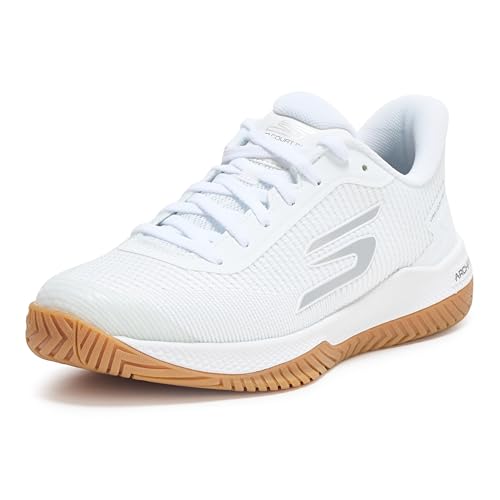 Skechers Women's Pickleball Viper Court Pro 2.0 Sneaker
  Skechers Women's Viper Court Pro Pickleball Sneaker
  ASICS Women's Gel-Dedicate 8 Tennis Shoes
 Email me these picks
Every item on this page with its current price, in one email, so you can shop it later or in pieces. No sales sequence.
Used only to send the list. You can also just read it here.Frequently asked questions
Can women wear running shoes to play pickleball?
It is not recommended for regular play. Running shoes use a rounded heel and soft midsole built for forward motion, which can roll under your foot during a fast lateral cut and raise ankle injury risk. Court shoes use a flatter outsole and reinforced sides specifically built to resist that rolling motion during side-to-side movement on the court.
Is a tennis or volleyball shoe okay to use for pickleball?
Yes, generally. Tennis, volleyball, and pickleball all demand similar lateral cutting and quick stops, so a well-built court shoe from any of those lines performs well on a pickleball court. Confirm the outsole is non-marking before playing indoors, since most facilities require it regardless of the shoe's original sport or brand.
What is the best budget pickleball shoe for women?
The ASICS Upcourt 6, a volleyball shoe at about $65, is the cheapest true court shoe in the women's catalog rather than a running shoe adapted for the court. It gives a beginner real lateral support without a large upfront cost, and is a reasonable starting point before investing in a dedicated pickleball shoe later.
How often should pickleball shoes be replaced?
Replace them once the outsole tread wears smooth, since that traction loss, not how worn the upper fabric looks, is what leads to slips during quick stops and cuts. Players on the court several times a week typically wear through a pair faster than a once-a-week social player would, sometimes within a single season.
Do women need more cushioning than men in a pickleball shoe?
Not inherently. Cushioning needs depend on body weight, playing frequency, and any existing foot or joint issues rather than gender. The core construction, lateral support, and outsole design across men's and women's lines are the same; the main practical difference is sizing, width, and overall fit for a given foot.
Researched from published specs and verified owner reviews, not play-tested by us, and not professional advice. Heavier paddles add load on the elbow and shoulder; ask a doctor or physical therapist about joint pain.