Best Pickleball Paddles for Control (2026)
The Selkirk Sport SLK Halo Control Max Pickleball Paddles (about $100) is our top pick for control: a 16mm carbon fiber paddle at about 7.85 ounces built specifically to soften contact and slow the ball down at the kitchen line.

The Selkirk Sport SLK Halo Control Max Pickleball Paddles are built around a 16mm carbon fiber face at about 7.85 ounces specifically to soften the paddle's response and slow the ball at the net. Compared to the Beginner tier, the construction is more purpose built for control, at a price that reflects that focus rather than an entry level build.
7.85 oz listed · 16 mm core · carbon fiber face
Beginner, intermediate and expert picks
Beginner
 JOOLA GRAF Edge 16mm Pickleball Paddle$49.95
The JOOLA GRAF Edge 16mm Pickleball Paddle pairs a 16mm carbon fiber face with a polymer honeycomb core at about 7.8 ounces for under $50, giving a new player the soft, controlled feel of a thicker core without a big price tag. It will not match a dedicated control paddle's fine tuned balance, but it is more than enough paddle to learn dinking and blocking on.
Check priceIntermediate
Selkirk Sport SLK Halo Control Max Pickleball Paddles$99.99The Selkirk Sport SLK Halo Control Max Pickleball Paddles are built around a 16mm carbon fiber face at about 7.85 ounces specifically to soften the paddle's response and slow the ball at the net. Compared to the Beginner tier, the construction is more purpose built for control, at a price that reflects that focus rather than an entry level build.
Check priceExpert
 Selkirk Sport LUXX Control Pickleball Paddle 19mm$199.99
The Selkirk Sport LUXX Control Pickleball Paddle 19mm pushes core thickness to 19mm, among the thickest cores in this catalog, trading nearly all pop for the softest possible touch on dinks, resets, and blocks. Compared to the Intermediate tier, you give up drive power almost entirely in exchange for the most forgiving feel available at the kitchen line.
Skip it if:A player who wants to end points with pace from mid court, since a 19mm core is built to absorb and soften contact rather than return it with speed.
Check priceWhat makes a pickleball paddle good for control?
Control does not mean slow or passive. It means the ball does what you intended when you hit it, whether that is a dink that dies just over the net, a reset that lands soft enough to reclaim the kitchen line, or a block that stops a hard drive dead rather than sending it off the paddle at an unpredictable angle. A control paddle earns that predictability mainly by absorbing energy at contact instead of returning all of it as pace.
Control comes mainly from core thickness. A thicker core, generally 16mm and up, absorbs more energy at contact than a thin one, which softens the ball's response and makes it easier to place a dink, a reset, or a block exactly where you want it rather than watching it pop up off the paddle face. Run your numbers through the paddle thickness calculator before you buy to see how the three common thicknesses, 13mm, 14mm, and 16mm, actually trade off pop against touch for your own swing.
Control focused paddles matter most at the non-volley zone, commonly called the kitchen, which extends 7 feet from the net on each side of a regulation court. Most points above the beginner level are decided in or right around that zone, in a slow, technical exchange of dinks and resets rather than a power rally from the baseline. A paddle that softens contact and gives you time to react is worth more there than a paddle that adds a few extra miles per hour to a drive you rarely hit from that position.
What core thickness gives the most control?
Among the paddles tracked here, core thickness runs from about 10mm up to 19mm, and control increases steadily as thickness goes up. A 16mm core, like the one on the JOOLA GRAF Edge 16mm Pickleball Paddle or the Selkirk Sport SLK Halo Control Max Pickleball Paddles, is the most common control oriented thickness and balances a soft feel with enough pop to still clear the net on a reset. A 19mm core, like the one on the Selkirk Sport LUXX Control Pickleball Paddle 19mm, goes further still, built for players who spend most of a point at the net and rarely need to drive the ball hard. There is no rule limiting core thickness or paddle weight, only a combined length plus width cap of 24 inches with length alone capped at 17 inches, so manufacturers are free to keep pushing thickness for players who want it.
Weight interacts with thickness in a way that is easy to miss. A midweight paddle, roughly 7.8 to 8.2 ounces, is the most common pairing with a control oriented core because it keeps paddle head speed manageable at the net while still driving through a reset when you need one. A heavier paddle on top of a thick core can start to feel sluggish to bring up in time on a fast exchange, and heavier or head heavy paddles also increase the load on the elbow and shoulder with every swing, so anyone managing joint pain or a history of tennis elbow should talk to a doctor or physical therapist before assuming more weight automatically means more control.
Does paddle shape matter for control?
Shape plays a smaller role than core thickness, but it is not nothing. A standard or widebody shape, rather than an elongated one, keeps the hitting face shorter and wider, which gives a larger margin for error on a dink that lands slightly off center. Several control paddles in this list, including the Diadem Warrior Edge Pickleball Paddle 16mm and the Gamma Obsidian 16 Carbon Fiber Pickleball Paddle with 16mm Core, keep the thick core without an elongated shape, which suits a player who wants maximum forgiveness at the net over the extra reach an elongated face offers. Our paddle shape guide covers this tradeoff directly.
Foam cores and control
A newer construction on some control oriented paddles replaces the traditional polymer honeycomb core with a foam core, which can soften contact and dampen vibration even further at a given thickness. The Vatic Pro V-Sol Pro 16mm paddle uses this foam core construction at 16mm, and it is worth comparing directly against a honeycomb core paddle of the same thickness if a soft, quiet feel at the net is your priority. Neither construction is universally better; it comes down to personal feel, which no spec sheet fully captures.
How much should you spend on a control paddle?
Control paddles do not require the biggest budget in this catalog. The JOOLA GRAF Edge 16mm Pickleball Paddle delivers a genuine 16mm carbon fiber build for under $50, which is enough paddle for most club and league players to develop a soft, reliable dink game. Spending more, up to the JOOLA GRAF Pro IV 16mm Pickleball Paddle w/Extended Sweet Spot near $150 or the Selkirk Sport LUXX Control Pickleball Paddle 19mm near $200, buys a wider or more forgiving sweet spot and a more refined balance rather than a fundamentally different level of control. If you already know 16mm is your target thickness, our pickleball paddles under $100 roundup narrows that same search by price.
Grip size and control
Core thickness gets most of the attention, but grip size affects touch just as directly. A grip that is too large limits the small wrist and finger adjustments that make a soft dink land where you want it, while a grip that is too small forces extra squeezing that tires the hand during a long point at the net. Measure your own hand with the ruler method, from the middle crease of your palm to the tip of your ring finger, and check it against our grip size calculator before assuming core thickness alone will fix an inconsistent dink game.
Control paddle options compared
| Paddle | Price | Core | Face | Best for |
|---|---|---|---|---|
| JOOLA GRAF Edge 16mm Pickleball Paddle | about $50 | 16mm honeycomb | Carbon fiber | Budget entry into control play |
| Selkirk Sport SLK Halo Control Max Pickleball Paddles | about $100 | 16mm | Carbon fiber | Purpose built control paddle |
| JOOLA GRAF Pro IV 16mm Pickleball Paddle w/Extended Sweet Spot | about $150 | 16mm honeycomb | Carbon fiber | Extended sweet spot with control focus |
| Selkirk Sport LUXX Control Pickleball Paddle 19mm | about $200 | 19mm honeycomb | Carbon fiber | Maximum thickness, softest touch |
How we chose these paddles
We did not play test these paddles in person. We selected paddles whose published core thickness is 16mm or greater, since thickness is the strongest verified driver of control among the specs manufacturers actually publish, and we favored listings that also state a carbon fiber or fiberglass face and a documented core material. Where a listing left weight, shape, or core material blank, we did not add a number of our own. Everything here comes from manufacturer specifications, USA Pickleball's approved paddle records where applicable, and verified owner reviews rather than from our own contact with the ball. We also cross checked pricing at the time of writing against the same listings, since core thickness and price do not always move together in this category the way they do in the power or spin categories.
Buying tips for a control focused paddle
Do not assume the thickest core available is automatically the right choice. A 19mm paddle like the Selkirk Sport LUXX Control Pickleball Paddle 19mm gives up nearly all pop, which is fine if your game is built around soft hands at the net but frustrating if you also need to drive the ball occasionally from mid court. A 16mm paddle is the more common middle ground for players who want more control than a standard paddle without giving up drive power entirely. And heavier paddles, control focused or not, still add load to the elbow and shoulder on every swing, so anyone managing joint pain or a history of tennis elbow should talk to a doctor or physical therapist before choosing a heavier control paddle over a lighter one. If joint comfort is your main concern rather than pure control, our paddles for tennis elbow guide narrows the field specifically around that priority.
Finally, keep the court itself in mind. A regulation court is 20 feet wide by 44 feet long with the net at 36 inches at the sidelines and 34 inches at the center, and the non-volley zone runs 7 feet from the net on each side. A control paddle is built for the game that plays out inside that 7 foot zone. If you are building your own court rather than only buying gear for a public one, check your layout against our court size calculator so the space you build actually supports the slow, technical rallies a control paddle is designed for.
Frequently asked questions
Also worth considering
 Selkirk Sport Amped Control Pickleball Paddles Full spec sheet
  Diadem Warrior Edge Pickleball Paddle 16mm Full spec sheet
 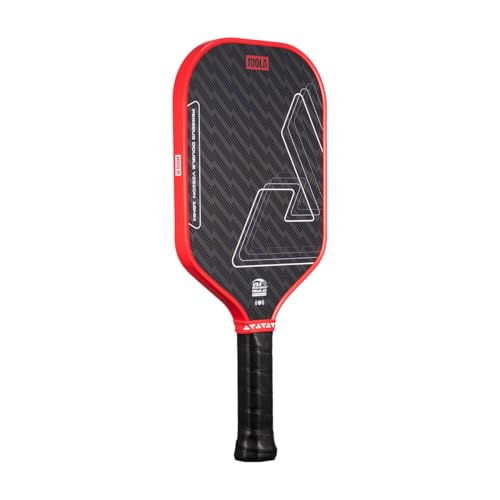 JOOLA Perseus Double Vision 16mm Pickleball Paddle Full spec sheet
  Gamma Obsidian 16 Carbon Fiber Pickleball Paddle with 16mm Core Full spec sheet
  Vatic Pro V-Sol Pro 16mm Full spec sheet
  JOOLA GRAF Pro IV 16mm Pickleball Paddle w/Extended Sweet Spot Full spec sheet
 Email me these picks
Every item on this page with its current price, in one email, so you can shop it later or in pieces. No sales sequence.
Used only to send the list. You can also just read it here.Frequently asked questions
What pickleball paddle gives the best control?
The Selkirk Sport SLK Halo Control Max Pickleball Paddles, about $100, is a purpose built control paddle with a 16mm carbon fiber face at about 7.85 ounces. For maximum control with less pop, the Selkirk Sport LUXX Control Pickleball Paddle 19mm goes further with one of the thickest cores available, near $200.
Does a 16mm paddle give more control than 13mm?
Yes. A 16mm core absorbs more energy at contact than a 13mm or 14mm core, softening the ball response and making it easier to place dinks and resets precisely. A 13mm or 14mm core returns more of that energy as pop, which favors power over touch. Most control focused paddles use a 16mm core or thicker.
Is a thicker or thinner paddle better for dinking?
A thicker paddle, generally 16mm and up, is better for dinking because it softens contact and gives a wider margin for error on a shot that needs to clear the net by only a few inches. A thin paddle tends to pop dinks up higher than intended, which is easier for an opponent to attack.
What is the difference between a control paddle and a power paddle?
A control paddle uses a thicker core, generally 16mm or more, to absorb energy and soften the ball response for precise placement at the net. A power paddle uses a thinner core, often 10mm to 14mm, to return more energy as pace on drives and serves. The two are trade offs on the same spectrum rather than separate categories.
Do control paddles work for beginners?
Yes. A control oriented, thicker core paddle is a common recommendation for beginners because it forgives mistimed hits and softens the ball at the kitchen line while a new player is still learning pace and placement. The JOOLA GRAF Edge 16mm Pickleball Paddle, under $50, is a straightforward example built at a beginner friendly price.
Does paddle shape affect control the way core thickness does?
Shape has a smaller effect than core thickness but still matters. A standard or widebody shape keeps the hitting face shorter and wider, which gives more margin for error on an off center dink than an elongated shape does. Core thickness remains the bigger factor for control, with shape acting as a secondary adjustment.
Researched from published specs and verified owner reviews, not play-tested by us, and not professional advice. Heavier paddles add load on the elbow and shoulder; ask a doctor or physical therapist about joint pain.